Life on four wheels has a funny way of stripping away your illusions about control.
Between finding a safe spot to park before dark, keeping the water tank filled, and managing whatever mechanical quirk decides to pop up next, you learn pretty quickly that pristine, uninterrupted perfection is a myth.
Most mornings start with the quiet hum of the morning chill, me firing up the stove for coffee, and Kenny—my trusty three-legged German Shepherd—stretching out on his rug, keeping a sleepy, faithful eye on my every move to make sure I don’t forget his morning routine.
Out here, if you wait for every condition to align perfectly before you turn the key, you’ll stay parked in the exact same spot forever.
That simple, rugged reality of the highway has taught me more about walking with Hashem than any polished theological lecture ever could.
For a long time, I watched believers—and often myself—staring down at our own spiritual dashboard, paralyzed by the fear that we aren’t “ready” enough, clean enough, or polished enough to move forward. We tell ourselves we will step into our purpose, help our neighbor, or lean into our calling once we finally get our act completely together.
But the God of Israel—the one true Elohim who is Echad, the indivisible, unified source of everything—never demanded human perfection. What He asks for is our sincere, wholehearted participation, trusting Him to supply the grace, strength, and completion that our natural weakness could never manufacture on its own.
Consider the heart of King David when he poured out his praise in Psalm 145. He wasn’t sitting on an untarnished pedestal of moral flawlessness; he was a man acquainted with deep stumbles and heavy scars, yet he simply opened his mouth and blessed the King. David grasped what the ancient Hebrew Scriptures call Tamim—not an unattainable, squeaky-clean track record, but a devoted, undivided heart.
While the world loves to judge by superficial scorecards and external flashiness, Adonai looks straight past the exterior into the kavanah, the deep intent and posture of the soul.
Cynics love to point fingers and scream “hypocrite” at anyone trying to walk a faith-filled path. And sure, performative, check-box religion is a toxic trap. But we must never confuse a hollow showman with an imperfect pilgrim who is genuinely trying to walk honestly before God.
This golden thread runs unbroken from the foundations of the Torah right through the prophetic warnings and into the New Covenant writings.
When Yeshua addressed the crowds, He fiercely dismantled empty, performative legalism while upholding the weightier matters of genuine heart-obedience.
The Apostle Paul leaned into this exact grace when he reminded believers that divine strength shines brightest precisely where human weakness is most exposed.
From Genesis to Revelation, the message is harmoniously unified: there is only One God, Adonai Echad, and He deliberately chooses flawed, ordinary vessels so that all the glory stays right where it belongs—with Him.
Grace was never an afterthought or a safety net tossed out when things went wrong; it was engineered into the very blueprint of creation because Elohim knew our frame from the dust.
Righteousness isn’t about walking a tightrope without ever slipping. As Proverbs tells us, even the righteous person may fall seven times, but they get right back up through the gritty, grace-filled work of Teshuvah—turning back toward home.
To walk humbly isn’t weakness; it’s the quiet courage to admit, “I can’t carry this load on my own steam,” and lean heavily on the arm of the Almighty.
So drop the heavy burden of self-grading and stop waiting for your life to look like a showroom floor. Bring your honest, stumbling steps to the King today, and trust the One God to finish what He started in you.
Ready to leave the sidelines behind? Don’t let the illusion of inadequacy keep you parked in one place. Take one sincere step of faith today right where you are.
Share this with a fellow traveler on the road, and drop a comment below to let me know how you’re stepping out this week!
-
-
There is something beautiful about beginnings.
Every time I slide my paddleboard into the water and Kenny hops around on the shoreline with his usual three-legged enthusiasm, I am reminded that life rarely starts under perfect conditions. Some mornings the water is choppy, the wind is stronger than expected, and my plans are far from polished. Yet if I stand on the bank waiting for everything to become ideal, I never launch.
That lesson sits at the very heart of Parashat Bereshit.
Bereshit opens with the majestic declaration that in the beginning, God created the heavens and the earth. Before there was order, there was chaos.
Before there was life, there was emptiness. Yet Adonai Echad, the One God, spoke, and creation responded. Light pierced darkness. Land emerged from the waters. Living creatures filled the earth.
Humanity was created in the image of God and entrusted with stewardship over creation. The portion also recounts humanity’s fall, Cain and Abel, and the spread of both sin and human civilization.
The Haftarah from Isaiah echoes the same theme by proclaiming that the One who stretched out the heavens is the same God who calls His people and sustains them. Creation is not the work of competing forces or multiple gods. Scripture consistently points us back to Adonai Echad, the Creator of all things, whose authority extends over every corner of existence.
The Brit Chadashah reinforces this truth by revealing that all things were made through the Word of God and that life and light are found in Him. The same God who spoke light into existence is still speaking life into dark places today.
The message is wonderfully consistent from Genesis to the Gospel accounts: there is one Creator, one King, one source of life, and one purpose behind creation.
As I reflected on these passages, I found myself thinking about how often we act like spiritual perfectionists.
We read about Adam walking with God, or we look at the grandeur of creation, and suddenly our own weaknesses feel overwhelming. We tell ourselves we’ll serve God once we’re stronger, pray once we’re more disciplined, or step into our calling once we’ve fixed every flaw. Yet Bereshit tells a very different story.
God began His work in a world that was without form and void. He brought order out of disorder. He did not wait for creation to perfect itself before He started creating.
That truth has followed me through countless miles of van life. There have been seasons when ministry plans felt incomplete, finances looked uncertain, and my next destination was little more than a guess on a map.
More than once I sat behind the steering wheel thinking I needed a better plan before taking the next step.
But life taught me what Scripture had already revealed. Nothing happens while standing still. The moment we move forward in faith, even imperfectly,
God meets us on the journey.
This is where the spirit of the Gospel shines.
God is not searching for flawless people. He is looking for willing hearts. The Hebrew concept of tamim is often misunderstood as perfection, but its deeper sense points toward wholeheartedness and sincerity.
Adonai is not asking us to become finished products overnight. He asks us to trust Him enough to take the next step.
The fall in Eden reminds us that humanity stumbles.
Cain’s story reminds us that sin crouches at the door. The generations that follow prove that human beings repeatedly fall short. Yet the story does not end there. Throughout Scripture, God continues drawing people back to Himself.
His grace was never an emergency adjustment to His plan. It was woven into His purposes from the beginning because He knew our weakness.
I think about this whenever I miss a paddle stroke and drift slightly off course.
Kenny certainly doesn’t stop believing I’m taking him on an adventure because I missed one stroke. He simply keeps going. In much the same way, our Heavenly Father is not shocked by every stumble.
He calls us to rise, repent, and continue walking. The righteous person is not the one who never falls. The righteous person is the one who gets back up and keeps moving toward God.
Bereshit challenges us to stop measuring ourselves by impossible standards. The Creator who formed galaxies from nothing is fully capable of working through imperfect people.
HaShem specializes in bringing order from chaos, purpose from confusion, and life from what appears lifeless. If He could transform a formless world into a masterpiece, He can certainly work through our unfinished lives.
Today the application is simple. Stop waiting for perfection before obeying God. Stop standing on the shoreline analyzing every wave. Stop believing the lie that your weaknesses disqualify you from participation in God’s purposes.
The Creator who said, “Let there be light,” is still calling people to step forward in faith. Bring Him your sincere heart, your imperfect effort, and your willingness to follow. He can accomplish far more through humble participation than through endless hesitation.
This week, identify one area where you’ve been waiting for perfect conditions before obeying God.
Maybe it’s prayer, ministry, reconciliation, generosity, sharing your faith, or pursuing a calling He has placed on your heart. Instead of waiting for flawless preparation, take one sincere step forward. Trust Abba Father with the outcome.
Just as creation began with God’s word and one act of divine initiative, your next season may begin with one faithful act of obedience.
Start where you are, walk with the One God who created all things, and let Him complete the work He has begun in you.
-
When you live out of a van and spend your mornings gliding across glass-still water on a stand-up paddleboard, you get a lot of quiet time to think. Just the other day, my three-legged German Shepherd, Kenny, was balancing up front on the board, ears perked, completely synced with every shift of my weight. Watching him navigate the water got me reflecting on how intricate and interconnected everything in this world really is.
We’ve all seen headlines about scientists attempting to recreate the origins of life in a lab—mixing chemicals, applying energy sources, and trying to form the fundamental building blocks of biology from non-living matter. It’s fascinating work, but it raises a subtle philosophical paradox that often gets overlooked: when a team of brilliant researchers designs a highly controlled environment, uses pure reagents, fine-tunes temperatures, and carefully time-controls reactions… what are they actually demonstrating?
On one hand, it shows what physical chemistry is capable of under very specific conditions.
On the other hand, it highlights a deep question: if it takes immense human intelligence, precise design, and active intervention to get chemicals to organize, does the experiment show that life happens naturally without guidance, or does it show that organizing life requires a Mind?
Think about it this way: an arrow flying across a field and hitting a bullseye doesn’t prove the wind shot it; it proves an archer was involved. In the same way, when intelligence is required to orchestrate a complex result in a lab, the “experimenter’s footprint” is on every step of the process. Even when looking at basic physics, we describe universe dynamics using “natural laws.” But in human experience, a law is a description of order—and order typically traces back to an intent, not pure randomness.
To assume matter and energy just happen to have intrinsic, highly ordered rules without any underlying reason is a massive assumption on its own. We often assume science and naturalism are identical, but every experiment carries implicit assumptions about how the universe is structured.
This exact tension brings us right into Parashat Bereshit (Genesis 1:1–6:8), where the ultimate narrative of design begins.
The Torah opens not with a chaotic collision of random forces, but with a singular, supreme Architect speaking order into existence out of the void. Bereshit bara Elohim—In the beginning God created—establishing from the very first verse that the universe is not an accident of physical chemistry, but a deliberate act of unity.
This foundational truth echoes seamlessly through the Haftarah portion in Isaiah (42:5–43:10), where Adonai declares that He alone stretched out the heavens, formed the earth, and gives breath to the people upon it. Isaiah reminds us that there is no other Creator beside Him; the intricate machinery of the cosmos exists to point back to the reality that God is One—Adonai Echad.
The Brit Chadashah ties this entire picture together in John 1:1–14 and Colossians 1:15–17, revealing that the divine Word (Davar) through which all things were made took on flesh, animating the creation and holding every single particle together by His power. When you weave the Torah, the Prophets, and the New Covenant together, the message is undeniable: creation is a single, cohesive masterpiece designed by one unified Source.
Living on the road, stripped down to the essentials in a van, you realize how easy it is to take the order around us for granted.
But the lesson of Bereshit is deeply practical for our daily lives right now. In a world full of noise, distraction, and fractured ideas, recognizing Adonai Echad means understanding that your life isn’t a series of random, disconnected events either. The same intentionality that balanced the ecosystems, set the laws of physics, and engineered the life in front of us is actively involved in orchestrating your path.
Next time you read about origin-of-life breakthroughs, ask yourself: is the chemistry doing the work here on its own, or is the intelligence setting up the test doing the heavy lifting?
Food for thought for your scrolling today. What do you think?
Drop your thoughts in the comments below, join the conversation, and make sure to subscribe and share this article with someone who loves exploring the deep connection between faith, science, and the ultimate Master Architect! -
In this season of Sh’mini Atzeret, something in the heart of God becomes visible that we often overlook.
After seven days of Sukkot—seven days of joy, celebration, worship, gathering, and dwelling with Him—God asks for one more day. One more moment. One more breath of closeness. The Hebrew word atzeret means to pause, to hold back, to linger, to stay with Me a little longer.
It is God saying, “Don’t leave yet.” And this year, that simple phrase struck me deeper than it ever has.
Because if Yeshua was born on the first day of Sukkot, then Sh’mini Atzeret—the eighth day—would have been His brit milah (circumcision), His covenant entry, His naming, His first shedding of blood as a son of Israel.
Which means the day Yeshua entered the covenant is the very day God says, “Don’t leave yet.” The written Word and the living Word align perfectly.
And this day is also Simchat Torah, the celebration of the Torah itself—not the giving of the Torah (that’s Shavuot), but the completion and restarting of the Torah reading cycle.
On this day, Israel finishes Deuteronomy, rolls the scroll back to Genesis, begins again with “In the beginning,” dances with the Torah, rejoices in the covenant, and celebrates the Word of God dwelling among them.
And here is the part that makes me smile—not in mockery, but in awe: on Simchat Torah, Israel celebrates the written Word while unknowingly celebrating the day the living Word entered the covenant. It’s not an insult; it’s a beautiful mystery.
God wove the Messiah into the calendar so perfectly that even those who don’t yet see Yeshua still rejoice on His covenant day.
The scroll is renewed, and the Messiah is named. The Torah cycle begins again, and the Messiah’s mission begins forward.
Day 1: God comes close to humanity. Day 8: God invites humanity to come close to Him. The incarnation and the covenant. The dwelling and the remaining. The birth and the belonging.
And through Yeshua, the invitation extends to us: abide in Me, remain in My love, I will not leave you, I am with you always. Sh’mini Atzeret becomes the feast where God reveals His desire not for more offerings or more ritual, but for presence.
For closeness.
For relationship.
For His people to linger.
So in this season, as we remember the day Yeshua entered the covenant and the day Israel rejoices in the Torah, hear the
Father’s voice again:
Don’t leave yet. Stay with Me.
Let Me enjoy you. Let Me delight in you.
Let Me remind you that you are valuable to Me.
Chag Sameach and Shabbat Shalom.
If this touched you, comment, share, and subscribe.
For more reflections, teachings, and weekly Torah‑based insights, visit my blog at websterbwrites.wordpress.com and share this message with someone who needs to feel the Father’s invitation to linger.
-
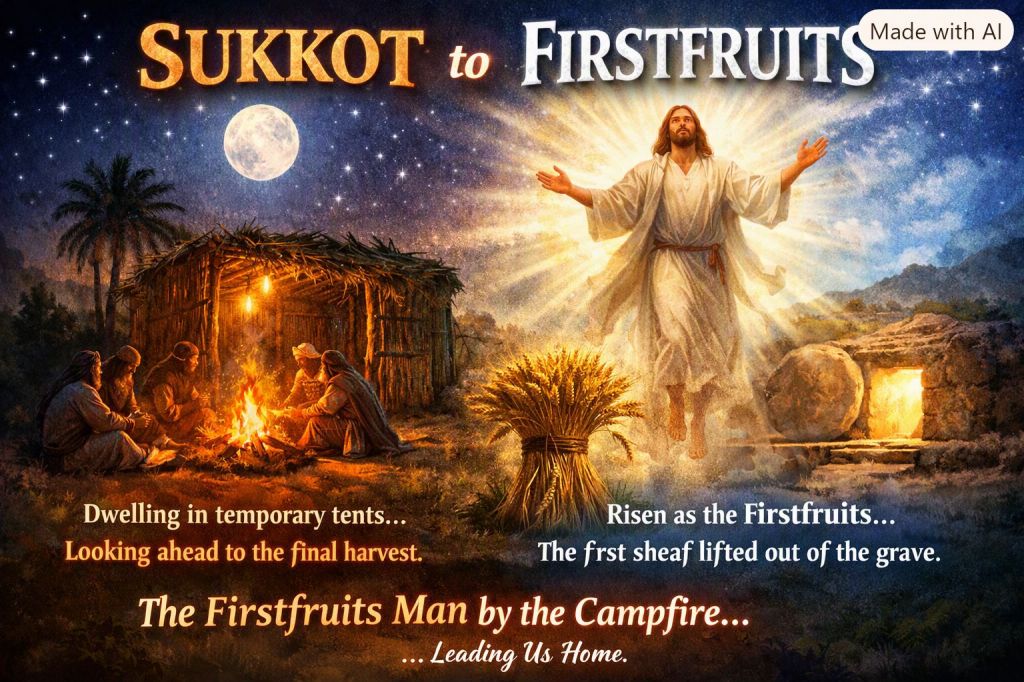
Sukkot slows us down in a way few moments in life can. The crackle of a fire, the open sky overhead, the fragile walls of a sukkah or even the simple shelter of a van parked under the stars—all of it invites us to remember where we’ve been and look forward to where God is taking us. It’s a feast of joy, of dwelling, of harvest, and of hope. But tucked inside this feast is a story that begins in a garden at dawn and stretches all the way into the Kingdom.
It starts with a woman named Miriam standing outside an empty tomb in the early morning darkness. She was crying, confused, heartbroken, and then she heard her name—“Miriam.” She turned and saw Yeshua alive. She grabbed Him, held Him, clung to Him like she would never let go again. But He said something strange: “Stop holding onto Me… I haven’t yet gone back to the Father.” Why would the risen Messiah say that? Why would He tell someone not to touch Him?
To understand that moment, we have to go back even further, to a command God gave Israel long before Miriam ever lived.On the day after the Sabbath during Passover week, the priest would take the first sheaf of barley—the very first life to come out of the ground—and lift it before YHWH.
Only after that offering could the people enjoy the harvest. That day is called Firstfruits. It’s the day Yeshua rose. He is the first life to come out of the ground forever—the Firstfruits of the resurrection. And just like the sheaf couldn’t be touched until it was lifted before God, Yeshua couldn’t be held until He ascended to the Father.
That’s why He said, “Stop holding onto Me.” He wasn’t rejecting her. He was fulfilling the feast.Now look at Sukkot.
The sukkah is fragile, temporary, open to the sky. It reminds us that our bodies—and our world—are temporary too.
But Sukkot is also the feast of joy because it celebrates the final harvest.
Not the first sheaf.
Not the beginning.
The ingathering.
The moment when God gathers His people like a farmer gathers the last of the season’s fruit. Firstfruits is the beginning. Sukkot is the end. Yeshua’s resurrection is the first sheaf. Sukkot celebrates the whole field.
Paul says our bodies are like tents—temporary dwellings we groan to leave behind. But the resurrection body is the permanent dwelling, the eternal sukkah.
Yeshua walked out of the tomb with the first completed, incorruptible body—the prototype of the Kingdom. Sukkot is the feast where we celebrate ahead of time what the resurrection will finish. It’s the feast where we say, “We’re waiting for that body. We’re waiting for that world. We’re waiting for that Kingdom.”
So here’s the whole teaching in one line: Yeshua rose on Firstfruits as the first sheaf, and Sukkot celebrates the day when the whole harvest—every believer, every saint, every one of us—is gathered into God’s Kingdom.
The fire we sit around is a reminder of the pillar of fire that led Israel. The temporary shelter is a reminder that our bodies are temporary too. But the resurrection body—the one Yeshua already has—is the permanent dwelling.
And Sukkot is the feast where we rehearse the ending of the story: God dwelling with us, us dwelling with Him, the harvest complete, the world made new. Yeshua is the Firstfruits.
We are the ingathering. And the God who led Israel through the wilderness is still leading us home. -
I keep Torah in the 21st century for one simple reason: the Bible never treats Torah as optional, divided, or abolished.
Torah is not split into “moral, ceremonial, and civil” categories the way modern Christianity often teaches. Those divisions came from later theologians, not from Moses, the prophets, Yeshua, or Paul.
In Scripture, Torah is one unified revelation of God’s character and God’s instruction for how His people should live. When Moses delivered the Torah, he never said, “Here is the moral part you must keep forever, and here is the ceremonial part you can ignore later.”
Instead, Deuteronomy 4:2 says, “Do not add to the word I command you, and do not take away from it.”
Torah was given as a whole, and its purpose was to shape a holy people who reflect the holiness of God.
Yeshua affirmed this directly. In Matthew 5:17–19 He said He did not come to abolish the Torah or the Prophets, and that not one stroke of the Torah passes away until heaven and earth pass away.
He kept Sabbath. He kept the feasts. He taught purity of heart. He upheld justice, mercy, and faithfulness—the “weightier matters of the Torah” (Matthew 23:23).
He intensified the commandments, teaching that anger is the heart‑root of murder and lust is the heart‑root of adultery.
Yeshua didn’t abolish Torah; He embodied it perfectly. Paul also upheld Torah.
He called it “holy, righteous, and good” (Romans 7:12).
He said “the law is spiritual” (Romans 7:14).
He used Torah to define sin (Romans 3:20), to teach righteousness (Romans 13:8–10), and to guide Gentile believers in holy living.
When Paul wrote that “all Scripture is profitable for teaching, correction, and training in righteousness” (2 Timothy 3:16), the only Scripture he had was Torah, Prophets, and Writings.
Paul applied the eternal moral core of Torah to Gentiles: no idolatry, no sexual immorality, no theft, no murder, no false witness, honoring parents, loving neighbor, caring for the poor, living with integrity.
He quoted the Ten Commandments.
He upheld Leviticus 18.
He taught generosity from Deuteronomy. He reaffirmed purity, justice, compassion, and holiness.
What Paul rejected was not Torah—it was the idea that Gentiles must enter the Sinai covenant system.
Circumcision as covenant entry, priestly rituals, temple sacrifices, land inheritance laws, and national penalties were tied to Israel’s covenant administration.
Gentiles were never commanded to take on those roles. But Paul never said Torah was abolished. He said the righteous requirement of the Torah is fulfilled in those who walk according to the Spirit (Romans 8:4).
That means Torah’s moral and ethical heart is still alive in the New Covenant.
So why do I keep Torah today?
Because Torah still teaches me how to live holy.
Because Torah still reveals God’s character.
Because Torah still defines righteousness. Because Torah still points to Messiah. Because Torah is still Scripture.
I don’t rebuild the temple system. I don’t perform priestly rituals. I don’t enforce ancient Israel’s civil penalties. But I absolutely embrace the parts of Torah that still speak directly to holiness, identity, worship, and wisdom.
I keep Sabbath as a rhythm of rest and devotion. I celebrate the feasts as prophetic pictures of Messiah’s work. I honor dietary boundaries as identity and discipline. I pursue purity, justice, compassion, and integrity because these reflect God’s eternal nature.
I study Torah because it is still God’s instruction, still profitable, still alive, still written on the heart in the New Covenant (Jeremiah 31:33).
Torah is not abolished. Torah is not divided. Torah is not discarded. Torah is God’s unified instruction for His people, and through Messiah and the Spirit, its righteousness is written on the heart of every believer—Jew and Gentile alike.
If this teaching encouraged you, please share it, subscribe for more, and leave a comment so we can grow together in truth and holiness.
-
For generations, many Christians have been taught that the Torah is divided into three neat categories: moral, ceremonial, and civil. It’s a tidy system, but it didn’t come from Moses, the prophets, Yeshua, or Paul. It came much later, created to explain why some commandments feel universal while others seem tied to ancient Israel’s national life. The problem is simple:
Scripture never divides Torah that way. Torah is one unified covenant revelation. It speaks to men, women, priests, farmers, judges, kings, widows, slaves, and foreigners. It speaks to purity, worship, justice, sexuality, economics, compassion, and holiness. It is not a flat list of 613 universal rules; it is a covenant constitution revealing God’s character and teaching His people how to walk in His ways. When modern Christianity says, “We only follow the moral law,” it unintentionally cuts Torah into pieces that the Bible never separated.
Yeshua didn’t divide Torah. He said not one stroke passes away until heaven and earth pass away. He reaffirmed the commandments, intensified them, internalized them, and lived them. He kept Sabbath. He kept the feasts. He taught purity of heart. He upheld justice, mercy, and faithfulness. He honored the Torah given to Moses while exposing the hypocrisy of those who twisted it. Yeshua didn’t abolish Torah; He embodied it.
Paul didn’t divide Torah either. He called it holy, righteous, and good. He used Torah to define sin, teach righteousness, guide Gentile believers, and reveal Messiah. He applied every eternal moral command of Torah to Gentiles. He quoted the Ten Commandments. He upheld sexual morality from Leviticus. He taught generosity from Deuteronomy. He affirmed honoring parents, rejecting idolatry, loving neighbor, and living with integrity.
Paul never rejected Torah. What he rejected was the idea that Gentiles must enter the Sinai covenant system—circumcision as covenant entry, temple rituals, priestly laws, land inheritance, and national penalties. Those parts of Torah were tied to Israel’s covenant administration, not to salvation in Messiah. But Paul absolutely expected Gentile believers to learn Torah, understand Torah, and walk in the righteousness Torah reveals. He said all Scripture is profitable for teaching, correction, and training in righteousness—and at the time he wrote that, “Scripture” meant Torah, Prophets, and Writings.
Messianic believers today stand exactly where the apostles stood. We do not rebuild the temple system. We do not attempt priestly rituals.
We do not enforce Israel’s national penalties. But we absolutely embrace the parts of Torah that still speak directly to holiness, identity, worship, and wisdom.
We keep Sabbath as a rhythm of rest and devotion.
We celebrate the feasts as prophetic pictures of Messiah.
We honor dietary boundaries as identity and discipline.
We pursue purity, justice, compassion, and integrity because these reflect God’s eternal character.
We study Torah because it is still Scripture, still revelation, still profitable, still alive.Torah is not abolished.
Torah is not divided.
Torah is not discarded.Torah is God’s instruction for His people, and through Messiah and the Spirit, its righteousness is written on the heart of every believer—Jew and Gentile alike. If this teaching encouraged you, please like, share, subscribe, and drop a comment to join the conversation.
-
Scripture teaches a righteousness that is lived, not imagined — a life of obedience, repentance, and faithfulness through Messiah. Believers are righteous in God’s sight, yet still human, still battling sin, and still walking blamelessly by returning to God daily.
Righteousness That Lives and Breathes
Modern church culture often reduces righteousness to a slogan or identity statement. But Scripture presents something far richer — a righteousness that is lived out in covenant faithfulness, shaped by repentance, and empowered by Messiah.
The foundation is simple:
A believer is righteous in God’s sight because of Messiah, and a believer still battles sin because they are human.
This tension is not a contradiction. It is the shape of the redeemed life.
What Scripture Means by “Righteous Before God”Luke describes Zechariah and Elizabeth as:“Righteous before God, walking blamelessly in all the commandments.”
This was before Yeshua’s birth, before the cross, before the resurrection.
They were not sinless.
They were faithful.
They were repentant.
They were obedient.
Their righteousness was not perfection — it was covenant loyalty. It was a life aimed at God, even when human weakness showed up.That same pattern continues in Messiah.
Through Yeshua, believers are forgiven, cleansed, and declared righteous. Their slate is wiped clean. Their standing before God is secure. Yet their humanity remains, and with it the daily need for repentance, humility, and course‑correction.Paul embodies this tension when he says:“I am crucified with Messiah.”“I am the foremost of sinners.”
(1 Timothy 1:15)
Identity: righteous in Messiah.
Condition: still battling sin.
Falling Into Sin vs. Living in Sin
Scripture makes a crucial distinction that every believer must understand.Falling Into Sin
This is the reality of human weakness. Even redeemed people stumble. John warns:
“If we say we have no sin, we deceive ourselves.”
(1 John 1:8)
Denying this doesn’t make us holy — it makes us blind.Living in SinThis is the lifestyle of rebellion — planning sin, making provision for sin, walking in lawlessness. John addresses this too:“Everyone who practices sin practices lawlessness.”
(1 John 3:4)
Redeemed people do not live in sin.
They do not pursue sin.
They do not make room for sin.
Their lives are aimed at obedience, shaped by repentance, and anchored in Messiah.The
Danger of Denying Our Ongoing Sinfulness
A growing message in modern Christianity claims that believers should never acknowledge themselves as sinners — that admitting ongoing sin somehow undermines grace or creates a “wrong identity.”
But Scripture says the opposite.
John warns that denying sin is self‑deception.
Paul confesses his ongoing struggle.
James says we all stumble.
Messiah teaches daily repentance.
The danger of the “I am not a sinner” message is simple:It blinds believers to the sin they still commit.
It shuts down self‑examination.
It replaces repentance with self‑affirmation.
This is not holiness — it is spiritual anesthesia.
The redeemed life is not built on denial.
It is built on truth, humility, and repentance.
The Biblical Balance of the Redeemed Life
Scripture presents a redeemed life that holds two truths together:
Believers are righteous in God’s sight through Messiah, and believers still battle sin because they are human.Redeemed people do not live in sin. Their direction is obedience. Their desire is faithfulness. Their hearts are turned toward God’s ways.
At the same time, redeemed people still fall into sin. They still stumble. They still need daily cleansing. John warns that denying this reality is deception (1 John 1:8), and Paul openly acknowledges his own struggle (Romans 7).This is the biblical balance:
Direction: obedience, faithfulness, repentanceCondition: human weakness, ongoing battleIdentity: righteous in Messiah
Reality: still in need of mercyThis is what Scripture calls walking blamelessly — not perfection, but a life aimed at God.
Believers are righteous in God’s sight through Messiah,
they still fall because they are human,
and they walk blamelessly by returning to God in daily repentance.This is the redeemed life.
This is the biblical life.
This is the life of someone who truly belongs to Yeshua.
Take a moment today to pause and return your heart to Messiah. Not in shame — but in honesty. Not in denial — but in humility. Righteousness is not pretending you’re perfect.
It is walking faithfully, repenting sincerely, and trusting the One who makes you clean. -

I’ve always felt that V’Zot HaBrachah hits differently when you’re living on the road. Maybe it’s because blessings feel more real when you’re chasing sunrises across states, or maybe it’s because endings and beginnings blur together when you’re vanlife‑bound with a three‑legged shepherd who thinks every lake is his personal kingdom. Either way, this portion lands right in the chest.
Moshe gives his final blessings—each tribe named, each future spoken over them—and then he climbs the mountain, sees the land he led us toward, and passes the mantle.
The Haftarah picks up with Joshua stepping into leadership, hearing the words we all need on the road:
“Be strong and courageous.”
The B’rit Chadashah echoes the same theme through the Transfiguration—Yeshua shining on the mountain, reminding us that revelation often comes when we’re willing to climb.Minimal lines. Maximum meaning.
How it hits today—out here on the roadI read this portion sitting in my van with Kenny sprawled across the floor like he owns the place.
We’d just finished a paddleboarding morning—glass‑smooth water, early light, Kenny barking at a duck like he was defending Israel itself. And as I dried off, the words of Moshe’s final blessing felt strangely familiar.
Life on the road is a constant transition. You’re always leaving something, always heading toward something, always standing between a goodbye and a promise. Moshe’s last act wasn’t dramatic—it was tender. He blessed people who were messy, stubborn, inconsistent… people like us. People who wander.
Then Joshua steps in, not with swagger, but with fear. And God doesn’t give him a map—He gives him courage. That’s vanlife in a nutshell. You don’t get certainty. You get motion. You get trust. You get the next mile.
And then the B’rit Chadashah ties it together with a mountaintop moment where Yeshua shines brighter than anything we can paddle toward. It’s a reminder that revelation isn’t always loud. Sometimes it’s quiet. Sometimes it’s the way the morning fog lifts off the lake. Sometimes it’s the way Kenny leans against me when I’m thinking too hard. Sometimes it’s the way a blessing from thousands of years ago still feels like it was written for someone living out of a van in 2026.
Blessings aren’t just words—they’re direction. Moshe’s blessings weren’t about nostalgia; they were about sending people forward. Joshua’s commissioning wasn’t about filling Moshe’s shoes; it was about stepping into his own. The Transfiguration wasn’t about dazzling the disciples; it was about preparing them for the journey ahead.
So I take it personally. Every time I pack up camp, every time Kenny hops in the van, every time we find another lake to paddle, I’m reminded that endings are just disguised beginnings. And blessings—real blessings—are meant to be carried.
If you’re wandering, transitioning, rebuilding, or just trying to figure out your next step, take this portion as your nudge. Speak a blessing over your own road. Claim courage for the next stretch. And climb your mountain—whatever it looks like—because revelation still happens when you show up.
-
AdventuresI woke up this morning in the van with that crisp Clear Lake air sneaking through the cracked window, Kenny already thumping his tail because he knows what Ha’azinu mornings mean: we’re heading to the water. And honestly, Ha’azinu hits different when you’re living mobile—when your “home” is wherever you park and your sanctuary is whatever shoreline you paddle out from.
Ha’azinu is Moshe’s final song, a sweeping reminder that God’s faithfulness doesn’t wobble even when ours does.
It’s raw, poetic, and painfully honest. The Haftarah in 2 Samuel 22 mirrors that same heartbeat—David singing his own survival song, remembering every moment God pulled him out of tight places. And then the B’rit Chadashah readings—Romans 10, Romans 12, and Hebrews 12—pull the whole thing forward into now: hearing, choosing, responding, and standing firm when life shakes.
Blended together, they form one long shoreline of truth: God speaks, rescues, restores, and expects us to live like people who remember.
Out on the paddleboard, the lake was glassy—one of those rare mornings where the world feels like it’s holding its breath. Kenny sat on the board like he owns the place, scanning for ducks he’ll never catch. And I found myself thinking about Moshe’s song: how he calls heaven and earth as witnesses. When you’re literally floating between sky and water, that imagery stops being metaphor and becomes geography.
Ha’azinu reminds me that wandering isn’t failure. Israel wandered. David wandered. Even the early believers wandered—geographically, spiritually, emotionally. What mattered wasn’t the wandering; it was remembering who guided them through it.
Romans 10 hits me hard in vanlife: faith comes by hearing. Out here, hearing is literal. The wind. The water. Kenny’s huffs. The quiet voice inside that only shows up when the noise of normal life is stripped away.
Romans 12 pushes it further: overcome evil with good. In vanlife, that looks like choosing patience at a crowded dump station, kindness at a Walmart parking lot, generosity when someone else’s rig breaks down. It’s small, but it’s real.
And Hebrews 12? That’s the kicker. We are receiving a kingdom that cannot be shaken. My van shakes. My plans shake. My bank account shakes.
But the kingdom doesn’t. And that steadiness is what keeps me grounded even when the road gets unpredictable.
Ha’azinu is Moshe’s final song calling heaven and earth to witness God’s faithfulness and Israel’s responsibility.
The Haftarah in 2 Samuel 22 echoes that theme through David’s victory song, celebrating God’s rescue and strength.
The B’rit Chadashah readings—Romans 10:14–21, Romans 12:14–21, and Hebrews 12:28 carry the message forward: hearing God, living transformed, and standing firm in an unshakable kingdom. Together they form a unified reminder that wandering is part of the journey, but remembering who guides us is what keeps us steady.
If you’re wandering—physically, spiritually, emotionally—take Ha’azinu with you this week.
Step outside, breathe the air, touch the water, or just sit still long enough to hear again. Let David’s gratitude, Paul’s challenge, and Hebrews’ promise anchor you. And if you need a moment of clarity, grab your board, your dog, or just your keys and go find a quiet stretch of creation to listen.

