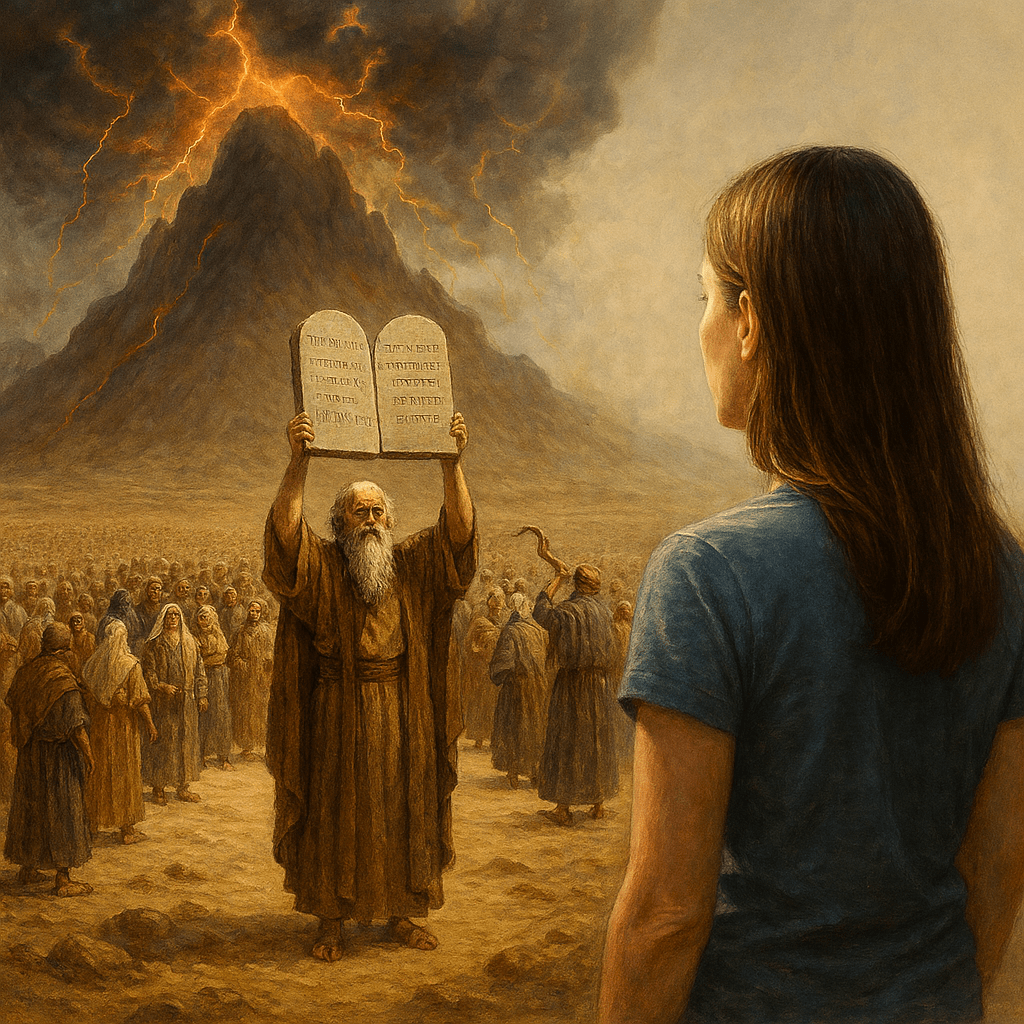
When Moses descends the mountain in Exodus 19:14, the people are standing at the edge of a moment that will define their identity for all generations. They wash their garments, set boundaries, and wait—because the Holy One is about to reveal Himself in a way no nation has ever experienced. The thunder, lightning, thick cloud, and the shofar blast that grows louder and louder are not theatrics; they are the trembling edges of heaven touching earth. The mountain shakes, the people shake, and Moses speaks while God answers in thunder. This is the same God Isaiah later sees in his vision—the One whose robe fills the Temple, whose presence shakes the thresholds, whose holiness overwhelms even the prophet who cries, “Woe to me, for I am undone.” Sinai and Isaiah’s vision echo each other: the same holiness, the same awe, the same call to transformation.
Into that trembling moment, God speaks the Ten Words. Not whispered. Not mediated. Spoken directly to the people. These Words—no other gods, no idols, honoring His Name, keeping Shabbat, honoring parents, protecting life, marriage, property, truth, and contentment—are not merely commandments; they are the DNA of covenant life. They reveal what it means to be a kingdom of priests and a holy nation. They are the foundation Yeshua later affirms and deepens when He teaches from a mountain, calling His disciples to live out the heart of Torah with integrity, mercy, and wholehearted devotion. The B’rit Chadashah writers echo this again and again: James calls it the “royal law,
” Peter calls believers “a chosen people, a royal priesthood,” and the writer of Hebrews reminds us that the God who shook Sinai still shakes the earth—not to destroy, but to refine.
The people, overwhelmed by the sound and sight of God’s presence, step back and beg Moses to speak on their behalf. Moses reassures them that this fear is not meant to push them away but to anchor them in reverence. Isaiah felt the same trembling when the seraph touched his lips with a coal, cleansing him and commissioning him. Israel at Sinai and Isaiah in the Temple both encounter the God who reveals Himself not to terrify but to transform. And in the B’rit Chadashah, this same God writes His Torah on hearts, not stone, calling His people to walk in holiness with joy rather than dread.
As the chapter closes, God gives the first practical instructions for worship: no idols of silver or gold, no altars built to impress, no steps that elevate the worshiper above others. Worship must be simple, humble, and centered on Him alone. This humility is echoed in Isaiah’s message to a nation tempted by alliances and self-reliance, and in the prophetic promise of a child who will carry the government on His shoulders—Wonderful Counselor, Mighty God, Father of Eternity, Prince of Peace. The One promised in Isaiah is the same One who fulfills the covenant purpose of Sinai, calling His followers to embody the holiness and justice revealed in the Ten Words.
When we read Yitro today, we are not just remembering an ancient moment; we are being invited into the same covenant rhythm. In a world that celebrates autonomy,Sinai calls us back to identity. In a culture that blurs truth, the Ten Words anchor us. In a time when noise drowns out the sacred, the shofar blast at Sinai reminds us that God still speaks. And as children of HaShem, we are called to live these truths—not as burdens, but as the shape of a life that reflects His character. The awe of Sinai, the vision of Isaiah, and the teachings of Yeshua all converge into one invitation: to be a people who carry holiness into ordinary days, who let God’s voice shape our choices, and who walk as a kingdom of priests in a world desperate for light.
If this reflection strengthens your walk, consider sharing it with someone who might need encouragement today. And if you’d like to keep journeying through the Torah portions with these blended insights, subscribe to the blog so you never miss a teaching. May these words take root in your life as you live out your calling as a child of HaShem.
 Chavurat Derekh HaMashiach
Leave a comment