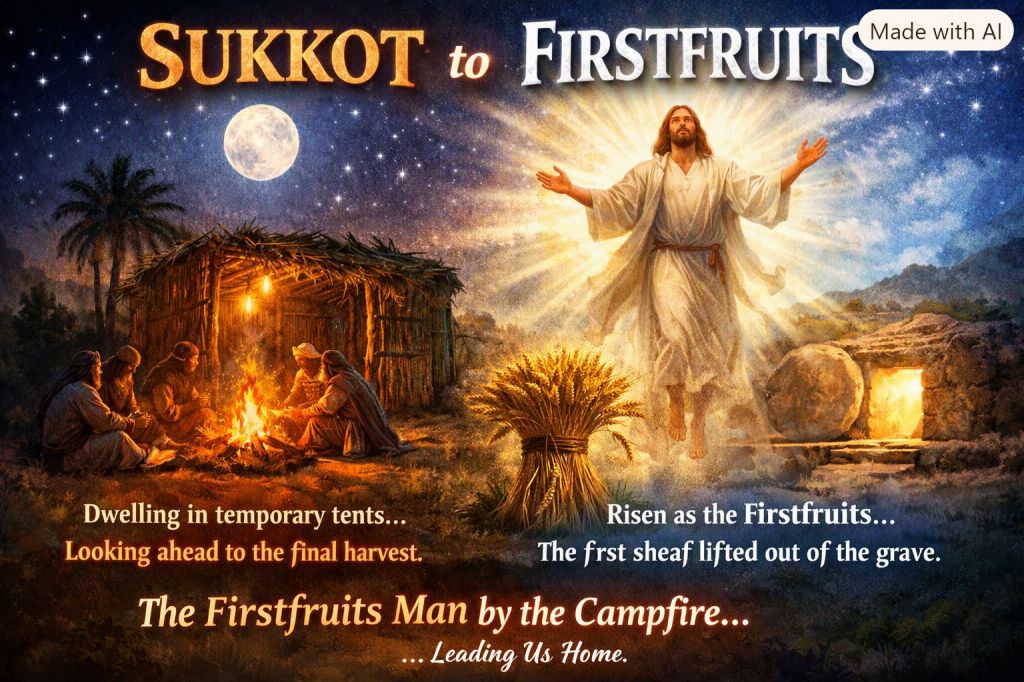
Sukkot slows us down in a way few moments in life can. The crackle of a fire, the open sky overhead, the fragile walls of a sukkah or even the simple shelter of a van parked under the stars—all of it invites us to remember where we’ve been and look forward to where God is taking us. It’s a feast of joy, of dwelling, of harvest, and of hope. But tucked inside this feast is a story that begins in a garden at dawn and stretches all the way into the Kingdom.
It starts with a woman named Miriam standing outside an empty tomb in the early morning darkness. She was crying, confused, heartbroken, and then she heard her name—“Miriam.” She turned and saw Yeshua alive. She grabbed Him, held Him, clung to Him like she would never let go again. But He said something strange: “Stop holding onto Me… I haven’t yet gone back to the Father.” Why would the risen Messiah say that? Why would He tell someone not to touch Him?
To understand that moment, we have to go back even further, to a command God gave Israel long before Miriam ever lived.On the day after the Sabbath during Passover week, the priest would take the first sheaf of barley—the very first life to come out of the ground—and lift it before YHWH.
Only after that offering could the people enjoy the harvest. That day is called Firstfruits. It’s the day Yeshua rose. He is the first life to come out of the ground forever—the Firstfruits of the resurrection. And just like the sheaf couldn’t be touched until it was lifted before God, Yeshua couldn’t be held until He ascended to the Father.
That’s why He said, “Stop holding onto Me.” He wasn’t rejecting her. He was fulfilling the feast.Now look at Sukkot.
The sukkah is fragile, temporary, open to the sky. It reminds us that our bodies—and our world—are temporary too.
But Sukkot is also the feast of joy because it celebrates the final harvest.
Not the first sheaf.
Not the beginning.
The ingathering.
The moment when God gathers His people like a farmer gathers the last of the season’s fruit. Firstfruits is the beginning. Sukkot is the end. Yeshua’s resurrection is the first sheaf. Sukkot celebrates the whole field.
Paul says our bodies are like tents—temporary dwellings we groan to leave behind. But the resurrection body is the permanent dwelling, the eternal sukkah.
Yeshua walked out of the tomb with the first completed, incorruptible body—the prototype of the Kingdom. Sukkot is the feast where we celebrate ahead of time what the resurrection will finish. It’s the feast where we say, “We’re waiting for that body. We’re waiting for that world. We’re waiting for that Kingdom.”
So here’s the whole teaching in one line: Yeshua rose on Firstfruits as the first sheaf, and Sukkot celebrates the day when the whole harvest—every believer, every saint, every one of us—is gathered into God’s Kingdom.
The fire we sit around is a reminder of the pillar of fire that led Israel. The temporary shelter is a reminder that our bodies are temporary too. But the resurrection body—the one Yeshua already has—is the permanent dwelling.
And Sukkot is the feast where we rehearse the ending of the story: God dwelling with us, us dwelling with Him, the harvest complete, the world made new. Yeshua is the Firstfruits.
We are the ingathering. And the God who led Israel through the wilderness is still leading us home.


Leave a Reply