Chavurat Derekh HaMashiach

Living the Journey, Sharing the WORD


  • For most of my Christian life, I believed Galatians “shut down” Sabbath observance. I used the same argument many Christians still use today:

    > “Paul said, ‘You observe days and months and seasons and years.’ 
    > That means Sabbath is obsolete.”

    I quoted it confidently. I thought it was airtight. 
    And then one day, I slowed down and actually read the context.

    That’s when everything changed.

    This article is for anyone who has ever used Galatians 4:10 the way I did—or has had it used against them—to argue that Christians should not observe the Sabbath or any part of Torah.

    The Problem: We Read Galatians Like Paul Was Talking to Jews

    Most Christians (including the old me) read Galatians as if Paul is rebuking Torah‑keeping Jews for going back to the Law.

    But Paul says something that makes that interpretation impossible:

    > “Formerly, when you did not know God, you were slaves to those which by nature are not gods.” 
    > — Galatians 4:8

    Who is he talking to?

    Not Jews. 
    Not Torah‑keepers. 
    Not Sabbath‑keepers.

    He’s talking to former pagans.

    People who worshiped idols. 
    People who followed astrological calendars. 
    People who had feast days for Zeus, Artemis, Dionysus, and the emperor. 
    People who practiced ritual fasting and food restrictions tied to pagan gods.

    These Gentiles had never kept the Sabbath in their lives.

    So when Paul says:

    > “You observe days and months and seasons and years…” 
    > — Galatians 4:10

    …he cannot possibly be talking about the Sabbath.

    You can’t “return” to something you never practiced.

    What Pagan Calendars Looked Like

    This is the part I never learned in church.

    Greco‑Roman religion had:

    – feast days for gods 
    – lucky and unlucky days 
    – astrological seasons 
    – ritual fast days 
    – new moon omens 
    – annual festivals tied to deities 
    – food restrictions connected to idol worship 

    Paul isn’t saying:

    > “Stop keeping the Sabbath.”

    He’s saying:

    > “Don’t go back to the pagan calendar system you came out of.”

    Once you see that, Galatians 4:10 stops being a weapon against Sabbath observance.

    Paul’s Real Issue: Justification, Not Obedience

    The entire book of Galatians is about one thing:

    Gentiles being pressured to adopt Jewish identity markers (circumcision, food laws, calendar) as a requirement for salvation and belonging.

    Paul is not attacking the practices themselves. 
    He is attacking the misuse of them.

    If Sabbath becomes a badge of justification, Paul says no. 
    If Sabbath becomes a rhythm of worship, rest, and identity in Messiah, Paul never condemns it.

    How do we know?

    Because Paul himself kept the Sabbath his entire life (Acts 13:14; 17:2; 18:4).

    Whatever Galatians means, it cannot mean “Sabbath is obsolete.”

    Acts 15 Actually Supports Sabbath, Not Abolishes It

    This is the part most Christians skip.

    James says:

    > “For Moses has been preached in every city from the earliest times and is read in the synagogues every Sabbath.” 
    > — Acts 15:21

    James assumes:

    – Gentiles will attend synagogue 
    – Gentiles will hear Moses taught 
    – Gentiles will grow into the ways of God over time 

    Acts 15 gives Gentiles minimum entry requirements, not a maximum ceiling.

    It’s not “Don’t keep Sabbath.” 
    It’s “Start here, and you’ll learn the rest every Sabbath as you grow.”

    So Is the Sabbath Still Applicable?

    Yes—because:

    – Paul never abolishes it. 
    – Galatians 4:10 is about pagan observances, not Torah. 
    – Acts 15 assumes ongoing Sabbath gatherings. 
    – Paul himself kept Sabbath. 
    – Sabbath predates Sinai (Genesis 2). 
    – Sabbath is part of creation, not just Israel. 

    The only thing Paul rejects is using Sabbath as a requirement for justification or as a boundary marker to divide Jew and Gentile.

    Sabbath as worship? 
    Sabbath as rest? 
    Sabbath as identity in Messiah?

    Paul never shuts that down.

    Why This Matters for Christians Today

    I used to argue against Sabbath because I thought Paul did. 
    But once I realized Paul was talking to pagans, not Torah‑keepers, the whole argument fell apart.

    The Sabbath isn’t a burden. 
    It isn’t legalism. 
    It isn’t obsolete.

    It’s a gift. 
    A rhythm. 
    A creation blessing. 
    A sign of God’s covenant faithfulness. 
    A weekly reminder that we are not slaves to Pharaoh, Rome, or modern life.

    And nothing in Galatians changes that.

    If this helped you rethink Galatians or gave you language for conversations you’ve had yourself, leave a comment and share this article with someone who’s wrestling through the same questions. Your voice helps others find clarity too.


  • Assumptions don’t appear out of thin air. They are born somewhere—shaped by stories we didn’t choose, moments we didn’t understand, and interpretations we didn’t realize we were making. By the time we’re adults, assumptions feel automatic, almost instinctive. But instinct is often just memory wearing a disguise.

    If Chapter 1 explored what an assumption is, this chapter explores where it comes from—because you can’t dismantle what you don’t understand.


    The Early Formation of Assumptions

    Long before we have language for our experiences, we begin forming patterns. A child who grows up in a loud, unpredictable home learns to read tone like a survival skill. A child who grows up in silence learns to fill in the blanks with imagination. A child who grows up around anger learns to anticipate danger. A child who grows up around avoidance learns to interpret distance as rejection.

    None of these children are “wrong.” 
    They’re simply adapting.

    But adaptation becomes interpretation. 
    Interpretation becomes expectation. 
    Expectation becomes assumption.

    And assumptions become the lens through which we see the world.


    The Brain’s Need to Fill the Gaps

    The human mind hates uncertainty. When something is unclear, the brain rushes to complete the picture. It fills in missing information with whatever feels familiar—even if familiar isn’t healthy.

    – Someone doesn’t text back → “They must be upset.” 
    – A friend sounds short → “I must have done something wrong.” 
    – God feels silent → “He must be disappointed in me.” 

    The brain isn’t trying to deceive you. 
    It’s trying to protect you.

    But protection built on old wounds becomes a prison.


    The Emotional Cost of Unexamined Assumptions

    Assumptions don’t just distort situations—they distort you.

    They create:

    – unnecessary anxiety 
    – relational tension 
    – spiritual confusion 
    – emotional exhaustion 
    – false narratives that feel true 

    Most people don’t realize how much energy they spend managing stories that never actually happened.

    You’re not just reacting to the moment—you’re reacting to every moment that ever felt like this one.

    That’s why assumptions feel so powerful. 
    They’re not about the present. 
    They’re about the past pretending to be the present.


    Spiritual Assumptions: The Most Dangerous Kind

    We don’t only make assumptions about people—we make them about God.

    – “If life is hard, God must be punishing me.” 
    – “If I don’t feel anything in prayer, God must be distant.” 
    – “If I fail, God must be disappointed.” 

    These assumptions don’t come from Scripture. 
    They come from experience—especially painful experience.

    A silent parent becomes a silent God. 
    A harsh authority figure becomes a harsh God. 
    A conditional relationship becomes a conditional God.

    We don’t see God as He is. 
    We see Him as we were taught to expect.

    And until we examine those expectations, we will confuse our assumptions with His character.


    Why This Matters

    You cannot heal what you cannot name. 
    You cannot grow beyond what you cannot see. 
    You cannot change a pattern you don’t realize you’re repeating.

    Understanding the birthplace of your assumptions is the first step toward freedom. 
    Not because it excuses the pattern—but because it reveals it.

    And once something is revealed, it can be rewritten.


    If this spoke to you…

    I’d love to hear what part of this chapter connected with your own story. 
    Feel free to comment, share, or pass it along to someone who might be carrying assumptions they never chose. 
    And stay tuned—there’s a new community space forming soon for those who want to walk this journey with others.


  • Most people imagine resilience as the ability to push harder, endure longer, or grit their teeth through impossible circumstances. But the kind of resilience Scripture reveals is quieter, stranger, and far more human. It’s not the strength of a warrior—it’s the strength of someone who refuses to walk away from a calling that hurts.

    Resilience in the Bible rarely looks heroic. It looks like Moses arguing with God in the wilderness. It looks like Jeremiah weeping. It looks like David hiding in caves. It looks like Yeshua withdrawing to lonely places to pray. It looks like people who stay in the story even when the story breaks their heart.

    And maybe that’s the part we forget: resilience isn’t the absence of breaking. It’s the refusal to let breaking become the end of the story.


    The Myth of the Unshakeable Person

    We tend to admire people who look unbothered—people who never flinch, never question, never show weakness. But Scripture doesn’t give us a single unshakeable hero. Not one.

    Moses begs God to send someone else. 
    Elijah collapses under a broom tree and asks to die. 
    Jonah runs. 
    Jeremiah cries so much he’s nicknamed “the weeping prophet.” 
    Even Yeshua says, “My soul is overwhelmed with sorrow to the point of death.”

    If the Son of God Himself felt the weight of His calling, why do we assume resilience means pretending we don’t?

    Real resilience is not emotional numbness. 
    It’s emotional honesty.


    The Resilience That Comes From Wrestling

    There’s a pattern woven through Scripture: God doesn’t form resilient people by removing struggle—He forms them through it.

    Jacob becomes Israel after wrestling all night. 
    Moses becomes a leader after forty years in Midian. 
    David becomes a king while running for his life. 
    Paul becomes an apostle through weakness, not strength.

    Resilience is not the product of comfort. 
    It’s the fruit of wrestling with God and refusing to let go.

    And here’s the part we rarely say out loud: resilience is not something you “achieve.” It’s something God grows in you while you’re convinced you’re failing.


    The Quiet Strength of Staying

    Sometimes the bravest thing you can do is stay when everything in you wants to run.

    Stay in the conversation. 
    Stay in the calling. 
    Stay in the healing process. 
    Stay in the place where God is shaping you. 
    Stay in the story long enough to see what God does next.

    Resilience isn’t loud. 
    It’s not glamorous. 
    It’s not Instagrammable.

    It’s the quiet decision to remain faithful when faithfulness feels like loss.


    When You Don’t Feel Strong Enough

    Maybe you’re in a season where you feel stretched thin. 
    Maybe you’re tired of being the strong one. 
    Maybe you’re wondering if you misheard God because the path is harder than you expected.

    If that’s you, hear this gently:

    Resilience is not something you muster. 
    It’s something God supplies.

    Your job is not to be unbreakable. 
    Your job is to stay open.

    Open to God. 
    Open to growth. 
    Open to the possibility that this season is forming something in you that comfort never could.


    A Closing Thought

    Resilience is not about becoming someone who never falls. 
    It’s about becoming someone who rises differently.

    Someone softer. 
    Someone wiser. 
    Someone more compassionate. 
    Someone who knows what it feels like to be held by God in the middle of the storm.

    If you’re in that storm right now, you’re not failing. 
    You’re being formed.


    If this spoke to you…

    I’d love to hear your thoughts. 
    What part of this resonated with your own journey?

    Feel free to comment, share, or pass it along to someone who needs a reminder that resilience doesn’t always look like strength—it often looks like staying.

    And keep an eye out… a new community space is coming soon for those who want to walk this path together.


  • When Glory Returns and the Name Is Revealed

    Part One of Ki Tissa ended with Moshe standing in the aftermath of Israel’s greatest national collapse—the Golden Calf. The covenant was shattered, the tablets broken, and the people unsure whether HaShem would remain with them.

    Moshe interceded, pleaded, and then asked the boldest request any human ever made:

    > “Show me Your glory.” (Exodus 33:18)

    HaShem agreed—but with a boundary. Moshe was placed in the cleft of the rock, covered by the hand of God, and allowed to see only the afterglow of divine presence. HaShem said:

    > “You cannot see My face, for no one can see Me and live.” (Exodus 33:20)

    That moment prepares us for one of the most important revelations in all Scripture.

    The First Time God Reveals His Name Fully (Exodus 34:6–7)

    When Moshe returns to the mountain with new tablets, HaShem descends in a cloud and proclaims His Name—not just the four letters, but the meaning behind them.

    > “YHVH, YHVH, El compassionate and gracious, slow to anger, abundant in lovingkindness and truth, keeping mercy to thousands, forgiving iniquity, transgression, and sin; yet by no means clearing the guilty…” 
    > (Exodus 34:6–7)

    This is the first time in the entire Bible that HaShem defines His Name.

    – Compassionate — He feels the suffering of His people. 
    – Gracious — He gives what is not earned. 
    – Slow to anger — He restrains judgment. 
    – Abounding in covenant love — His loyalty outlasts human failure. 
    – Faithful — He keeps His promises. 
    – Just — He does not ignore sin.

    This becomes the most quoted description of God in the entire Tanakh (Numbers 14:18; Nehemiah 9:17; Psalm 103:8; Joel 2:13; Jonah 4:2).

    The prophets don’t invent new theology—they echo this moment.

    But Didn’t HaShem Say No One Can See His Face?

    This is the tension many readers feel.

    Exodus 33:20
    “No one can see My face and live.”

    Yet Scripture also says:

    – Jacob: “I have seen God face to face” (Genesis 32:30) 
    – Moses: “HaShem spoke to Moses face to face” (Exodus 33:11) 
    – The elders: “They saw the God of Israel” (Exodus 24:10–11) 
    – Isaiah: “My eyes have seen the King, YHVH of Hosts” (Isaiah 6:5)

    Is this a contradiction?

    No—because “face” has two meanings in Scripture.

    1. “Face” as God’s unfiltered essence

    This is what Exodus 33:20 refers to.

    No human can behold the infinite, unmediated, unshielded glory of the Eternal One. 
    This is why Moshe is hidden in the rock. 
    This is why Isaiah cries out, “Woe is me!” (Isaiah 6:5). 
    This is why Ezekiel collapses (Ezekiel 1:28).

    The fullness of God’s essence is too overwhelming for mortal flesh.

    2. “Face” as God’s manifested, relational presence

    Throughout the Tanakh, HaShem appears in visible, embodied forms:

    – The Angel of HaShem who speaks as God and receives worship (Exodus 3:2–6; Judges 6:11–24). 
    – The Man who wrestles Jacob (Genesis 32:24–30). 
    – The Commander of HaShem’s armies who receives worship from Joshua (Joshua 5:13–15). 
    – The Glory of HaShem appearing in human-like form (Ezekiel 1:26–28).

    These are not metaphors. 
    The text describes physical encounters.

    The B’rit Chadashah clarifies the pattern:

    – “No one has ever seen God; the only Son… has made Him known.” (John 1:18) 
    – “He is the exact representation of His being.” (Hebrews 1:3) 
    – “The Messiah is the visible image of the invisible God.” (Colossians 1:15)

    The invisible essence of HaShem cannot be seen. 
    But HaShem can and does reveal Himself in visible, embodied form.

    This is how Jacob, Moses, Isaiah, and others survive.

    They are not seeing the infinite essence—they are seeing HaShem as He chooses to reveal Himself.

    Elijah and the Haftarah: When HaShem Vindicates His Name (1 Kings 18:1–39)

    The Haftarah mirrors Ki Tissa’s themes:

    – Israel sins. 
    – A mediator intercedes. 
    – HaShem reveals Himself. 
    – The people return to the covenant.

    On Mount Carmel, Elijah confronts a nation that has made its own “golden calf”—Baal.

    Just as Moshe stood between Israel and judgment, Elijah stands alone against 450 prophets.

    And HaShem answers with fire from heaven (1 Kings 18:38).

    The people fall on their faces and cry:

    > “YHVH—He is God! YHVH—He is God!” (1 Kings 18:39)

    The Name revealed in Exodus 34 is vindicated again.

    The B’rit Chadashah: The Glory Returns in Yeshua

    Paul directly references Ki Tissa when he writes:

    > “If the ministry that came with glory… 
    > how much more glorious is the ministry of the Spirit?” 
    > (2 Corinthians 3:7–18)

    Moshe’s face shone with reflected glory. 
    Believers are transformed by indwelling glory.

    John echoes the same theme:

    > “The Word became flesh and tabernacled among us, 
    > and we beheld His glory.” 
    > (John 1:14)

    The glory that passed by Moshe now walks among people. 
    The Name proclaimed in Exodus 34 is embodied in Yeshua:

    – Compassionate (Matthew 9:36) 
    – Gracious (John 8:11) 
    – Slow to anger (Luke 9:54–56) 
    – Abounding in steadfast love (John 13:1) 
    – Faithful (Revelation 19:11) 
    – Just (Acts 17:31)

    The God who hid Moshe in the rock now reveals Himself through the Son.

    Living This Today: The Name That Shapes Us

    1. HaShem’s character is the anchor, not our performance
    Israel failed spectacularly with the Golden Calf. 
    Yet HaShem revealed His Name after their failure.

    Your worst moment does not cancel His covenant love.

    2. HaShem still meets us in the “cleft of the rock”
    We often want full clarity, full answers, full revelation. 
    But HaShem gives us what we can bear—enough to trust Him, not enough to control Him.

    3. Glory transforms us more than effort
    Like Moshe, we reflect what we behold. 
    Transformation flows from presence, not pressure.

    4. Mercy and justice are not opposites
    Exodus 34 holds both together. 
    A mature walk embraces compassion and accountability.

    Choose one area of your life where you feel like Israel at the Golden Calf—ashamed, impatient, or spiritually scattered.

    Bring it before HaShem, using the Name He revealed:

    – Compassionate 
    – Gracious 
    – Slow to anger 
    – Abounding in steadfast love 
    – Faithful 
    – Just 

    Ask Him to reveal His glory—not the full face you cannot bear, but the afterglow that guides your next step.

    Then choose one practice this week that places you in the “cleft of the rock”:

    – Ten minutes of Scripture meditation 
    – A Sabbath pause 
    – A journal entry naming where you’ve seen His compassion 
    – A conversation where you extend grace 
    – A moment of worship where you simply sit in His presence 

    Let the glory that transformed Moshe begin to transform you.


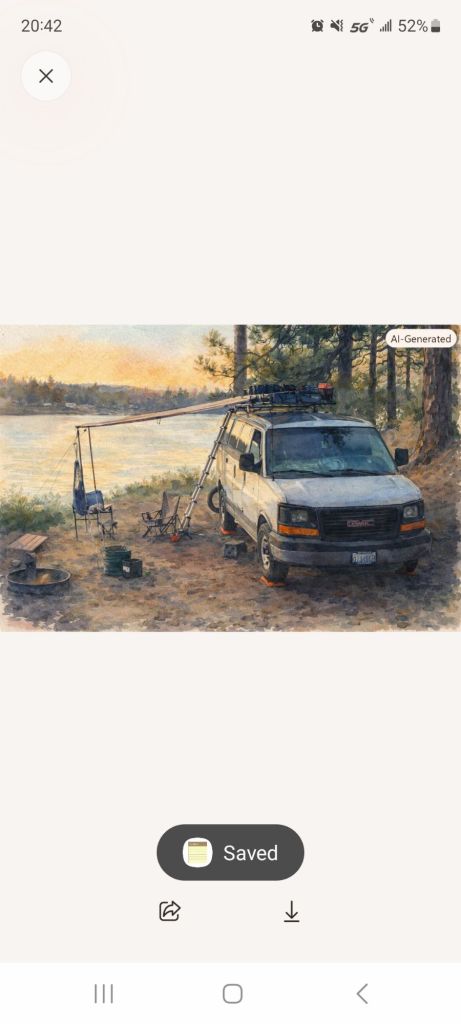
  • Living in a van teaches you things you didn’t know you needed to learn. Some lessons are big—patience, presence, trust. Others are small but surprisingly spiritual, like how to keep a compost toilet from announcing itself to the entire van. After a few months on the road with Kenny, I’ve realized the two aren’t as separate as they seem.

    When you live in a tiny space, nothing hides. Not your habits, not your moods, not your smells. Everything you ignore eventually asks for your attention. And in its own strange way, that’s part of the gift of vanlife: it keeps you honest.

    The Practical Side: What Actually Works
    A compost toilet doesn’t have to smell bad. It only smells when something is out of balance—too much moisture, not enough carbon, or not enough airflow. Once I understood that, the whole system made sense.

    These are the rhythms that keep my van fresh:

    – A scoop of dry carbon every time. Coconut coir, sawdust, shredded paper—anything that absorbs and balances.
    – Keeping the chamber dry. Moisture is the enemy of freshness.
    – A small vent fan pulling air out of the chamber. When mine died once, the difference was immediate.
    – Stirring the solids regularly so everything stays aerobic.
    – A weekly wipe‑down with vinegar to keep the space clean and simple.

    These habits aren’t complicated, but they matter. In a van, the smallest routines shape the whole atmosphere.

    Vanlife-Specific Tricks That Make a Difference
    Some things you only learn by living in the space:

    – Keep your carbon material within reach or you’ll skip it.
    – Start with a dry base layer so the whole chamber stays balanced.
    – Use a moisture absorber in the bathroom area to keep humidity down.
    – Don’t overfill the solids bin—airflow is everything.

    And then there’s Kenny, who has a way of teaching me patience by knocking over the carbon bucket at the exact wrong moment. If a three‑legged dog with a curious streak can’t accidentally make a mess of your setup, you’ve built it right.

    The Spiritual Angle: What This Taught Me About Inner Life
    Somewhere along the way, I realized composting is a quiet metaphor for the soul.

    Everything breaks down into something else. Everything transforms. Everything needs the right balance to stay healthy. And when something starts to smell—literally or figuratively—it’s usually a sign that something inside needs air, light, or a little more “carbon” to bring things back into harmony.

    Living in a van makes that impossible to ignore. You can’t shove things into a spare room. You can’t pretend you don’t notice. You deal with what’s in front of you, and in doing so, you learn to deal with what’s inside you too.

    There’s a kind of grace in that. A kind of honesty. A kind of slow, steady transformation that doesn’t need to be loud to be real.

    Why I’m Sharing This
    Vanlife isn’t just logistics. It’s a way of paying attention—to your space, your habits, your inner world, and the quiet ways the Father nudges you toward balance. If you’ve been following my journey, or if you’re curious about the spiritual side of simple living, this is the kind of thing I’ll be writing more about: the intersection of daily life, practical wisdom, and the slow work of becoming more whole.

    And if you’re new here, welcome. Kenny and I are glad you’re along for the ride.

    Would you like the next article in this series to focus on water management, trash, power, or another vanlife rhythm that also carries a deeper layer?


  • Communication is fragile. A single text message can sound encouraging in the morning and insulting at night, not because the words changed, but because we did. We fill in the blanks with our mood, our fears, our expectations.

    We do the same thing with Scripture.

    Every time we approach the Word, we bring our upbringing, our wounds, our denominational lenses, and our assumptions. And unless we’re honest about that, we risk reading our own voice into God’s mouth.

    This is the difference between eisegesis and exegesis:

    – Eisegesis reads into the text what we already believe. 
    – Exegesis draws out of the text what God actually said.

    Charles Spurgeon warned about this long before smartphones existed:

    > “Do not give heed to any man who reads his own mind into the Scriptures, but to the man who lets the Scriptures speak for themselves.” 
    > —Charles Spurgeon


    When Someone Puts Words in Your Mouth

    Think of a time someone misunderstood your intentions. Maybe they assumed your tone or motive. Maybe they accused you of something you never said. That sting you felt? That frustration?

    That’s exactly what we do to God when we project our assumptions onto His Word.

    A.W. Tozer captured this danger clearly:

    > “What comes into our minds when we think about God is the most important thing about us.” 
    > —A.W. Tozer

    Because what we assume about God shapes what we think He meant.


    Assumptions vs. Facts

    An assumption is a belief accepted as true without evidence. 
    A fact is a truth that remains true whether you believe it or not.

    John MacArthur put it bluntly:

    > “The greatest danger in interpreting Scripture is assuming you already know what it means.” 
    > —John MacArthur

    Assumptions feel solid because they’re familiar. Facts are solid because they’re true.


    The Echo Chamber of Belief

    When we approach Scripture to confirm what we already believe, we aren’t studying—we’re searching for an echo.

    Jesus confronted this repeatedly:

    > “You have heard it said… but I say to you…” (Matthew 5)

    He wasn’t correcting Scripture. He was correcting assumptions about Scripture.

    Beth Moore describes this beautifully:

    > “If we approach the Bible looking only for what we already believe, we will never be changed by it.” 
    > —Beth Moore

    The Word is meant to transform us, not validate us.


    A Case Study: Philippians 4:13

    > “I can do all things through Christ who strengthens me.”

    Most of us have heard this used as a motivational slogan—athletics, business, personal goals. But when you read the entire chapter, Paul is talking about contentment in suffering, not achievement in success.

    Joyce Meyer often reminds her listeners:

    > “Philippians 4:13 is not about winning. It’s about enduring.” 
    > —Joyce Meyer

    Context dismantles assumption.

    Tony Evans adds:

    > “A text without a context is a pretext for a proof text.” 
    > —Tony Evans

    In other words, if you rip a verse out of its setting, you can make it say anything you want.


    The Posture of Exegesis

    Exegesis invites us to:

    – listen instead of assume 
    – observe instead of react 
    – surrender instead of control 
    – discover instead of defend 

    Billy Graham summarized this posture simply:

    > “The Bible is the authority. Not my feelings. Not my opinions. Not my traditions.” 
    > —Billy Graham

    When we let Scripture speak, it often surprises us. Sometimes it confronts us. Sometimes it comforts us. But it always transforms us.


    Study Guide

    1. Recall a time someone misunderstood your intentions. 
    How did it feel to have “words put in your mouth”? 
    Write a few sentences about that moment and how it parallels what we sometimes do to God.

    2. Define “Assumption.” 
    Then define “Fact.” 
    Write one example of each from your own life.

    3. Exercise: Philippians 4:13 
    – Write down what you’ve always believed the verse meant. 
    – Read the entire chapter. 
    – Write down what Paul is actually talking about. 
    – Compare the two. 
    – What changed? What surprised you?


    Here are comma‑separated hashtags tailored to this article’s themes: interpretation, exegesis vs eisegesis, assumptions, Scripture study, and spiritual growth. They’re tuned for Facebook, Instagram, and your blog ecosystem.


  • A man recently accused me of saying something I never said. He filled in the blanks with his own assumptions, then argued with the version of me he created in his head. And as frustrating as that moment was, it reminded me of something far bigger:

    We do the exact same thing to Scripture.

    We hear a phrase, a verse, or a sermon, and our minds instantly supply the rest. We respond to our assumptions, not the actual text. Then we defend those assumptions as if they were handed down from Sinai.

    This isn’t a “church problem.” 
    It’s a human problem.


    How We Mishear God the Same Way We Mishear Each Other

    If we can twist each other’s words in real time—while texting, talking, or debating—how much easier is it to twist a text written thousands of years ago, in a different language, culture, and worldview?

    Most people don’t do it maliciously. 
    They do it because:

    – they trust the preacher 
    – they trust the tradition 
    – they trust the denomination 
    – they trust the version of Christianity they inherited 

    But trust doesn’t equal truth.

    And sincerity doesn’t equal accuracy.

    Over the years, I’ve visited more denominations and fellowships than I can count. Not to judge them, but to understand them. And here’s the pattern that never changes:

    – Every group has something solid. 
    – Every group has something off. 
    – Every group thinks their interpretation is the one God endorses. 

    Even in Hebrew Roots and Messianic circles—which, in my experience, come closest to the original context—there are still blind spots, assumptions, and traditions that slip in unnoticed.

    This isn’t about attacking any group. 
    It’s about recognizing that no group is immune to human filters.

    Most believers don’t actually test what they hear. 
    They assume the preacher is right. 
    They assume the commentary is right. 
    They assume the tradition is right.

    But the Bereans didn’t assume. 
    They checked.

    And they didn’t check Paul against the New Testament—it didn’t exist yet. 
    They checked him against the Scriptures they did have. The Tanakh and specifically the Torah

    If they had to test Paul, what makes us think we don’t have to test our pastors?

    Ignorance Isn’t a Sin… Until You Choose to Stay There

    I don’t blame anyone for being misled. 
    I don’t blame anyone for inheriting traditions. 
    I don’t blame anyone for trusting the people who taught them.

    But once you know better, you’re responsible for doing better.

    Once you realize you might have been taught through someone else’s filter, you no longer have the luxury of shrugging and saying, “Well, that’s just what my church believes.”

    After reading this, you can’t claim you didn’t know. 
    You can’t claim no one ever told you to check. 
    You can’t claim ignorance without admitting it’s now a choice.

    If the Bible says one thing, and your preacher says another, you are not obligated to defend the preacher.

    If Scripture contradicts your denomination’s tradition, you are not obligated to protect the tradition.

    If the Word of God challenges what you’ve always believed, you are not obligated to cling to your comfort.

    You are obligated to the truth.

    And truth doesn’t fear questions.

    Your Next Step

    Don’t take my word for anything. 
    Don’t take your pastor’s word for anything. 
    Don’t take your denomination’s word for anything.

    Read. 
    Study. 
    Compare. 
    Question. 
    Test everything.

    If the Bible says something plainly, and a human being says something else, choose the One who cannot lie over the one who can be mistaken.

    Your faith is too important to outsource.


  • The opening chapters of Ki Tissa move from sacred order to heartbreaking collapse. HaShem gives Moshe the final instructions for the Mishkan—incense, anointing oil, priestly service, the bronze laver, the census offering, and the reminder that Shabbat is the covenant sign. Everything is intentional. Everything is holy. Everything is about drawing near.

    Then the story fractures.

    While Moshe is on the mountain receiving the tablets written by the very finger of God, the people below lose patience. Fear becomes idolatry, idolatry becomes chaos, and the Golden Calf rises from the fire. The covenant is shattered, and Moshe breaks the tablets to show what the people have already broken in their hearts.

    Yet even in judgment, mercy begins to rise.

    Moshe intercedes, refusing to move forward without the Presence. He sets up the Tent of Meeting, and HaShem meets him there “as a man speaks to his friend.” In the middle of Israel’s failure, God still draws near.

    Then comes the boldest request in the Torah: 
    “Show me Your glory.”

    HaShem answers with both intimacy and boundary. Moshe will see His goodness, His compassion, His Name—but not His face. Not the unfiltered fire of eternity. So Moshe is placed in the cleft of the rock, covered by the hand of God, and allowed to see the afterglow of glory.

    This is where the first half of Ki Tissa pauses: a people forgiven but not yet restored, a leader exhausted but still pleading, and a God who reveals just enough to keep hope alive.

    As we walk through this first half of Ki Tissa, take a moment to sit with the tension: human failure, divine mercy, and the longing to see God more clearly. What part of this story mirrors your own journey right now?


  • I spent most of my life believing the prodigal son was my story. I loved God sincerely as a young man, drifted, hardened, lived life on my own terms, and eventually came home. For years, that parable felt like my autobiography.

    But something shifted. I started seeing myself in a character I never expected.

    Not the younger son. 
    The older brother.

    Not the faithful one. 
    The resentful one.

    Not resentful toward people… 
    but toward the Father Himself.

    That realization reframed everything—my past, my faith, and the long road that eventually led me into Messianic Judaism. I wasn’t wandering because I was unstable. I was wandering because I was searching. Searching for the Father’s heart. Searching for home. Searching for the place where my spirit finally exhaled.

    And in that search, I carried quiet resentment:

    – Why didn’t I “get it” sooner? 
    – Why wasn’t my transformation dramatic? 
    – Why did others find home easily while I wandered for years? 
    – Why did my story feel less valuable? 

    I wasn’t jealous of anyone else’s celebration. 
    I was frustrated with my own journey.

    But the Father’s words to the older brother are the same words He whispered to me:

    *“Everything I have is yours. 
    You’ve always been with Me.”*

    My wandering didn’t disqualify me. 
    My searching didn’t annoy Him. 
    My resentment didn’t shock Him. 
    My slow growth didn’t disappoint Him.

    He was leading me the whole time.

    And when I finally stepped into Messianic Judaism—whether in a full synagogue service or a simple one‑hour Torah study—I felt something I had never felt before:

    Home.

    Not because it was trendy. 
    But because it was ancient. 
    Because it honored the whole story—Torah to Messiah, covenant to fulfillment.

    And suddenly, my entire journey made sense.

    I wasn’t the prodigal returning from rebellion. 
    I wasn’t the older brother standing outside in resentment. 
    I was a son learning the Father’s heart.

    You don’t have to become Messianic to experience what I’m describing. This isn’t a call to convert. It’s a call to look honestly at your own heart.

    If you’ve ever felt resentment toward God—about your story, your timing, your growth, your unanswered questions—you’re not alone. I’ve been there.

    You can take a step today, right where you are, inside your own tradition:

    – Ask the Father to reveal any quiet resentment you’ve been carrying. 
    – Release the belief that your story should look like someone else’s. 
    – Invite Him to reshape how you see Him, and how you see yourself. 
    – Let Him show you that He’s been leading you—even in the wandering. 

    You don’t need a new denomination to draw closer to Him. 
    You just need a willing heart and an honest conversation with the Father.


    #faithjourney, #messianicwalk, #spiritualgrowth, #healingwiththeFather, #identityinGod,


  • Science and religion are often framed as if they’re locked in a tug‑of‑war, each pulling for control of truth. But that picture has never matched the way real people experience the world. Most of us live in a reality where curiosity and reverence sit side by side, where the beauty of a nebula and the beauty of a Psalm speak to the same human longing. The supposed conflict between science and faith only appears when we force them into roles they were never meant to play.

    Science is the study of structure, pattern, and process. It reveals how creation works at every scale, from the swirl of galaxies to the dance of electrons. It shows us the craftsmanship of the world with astonishing clarity. Religion, by contrast, is the search for meaning, purpose, identity, and relationship. It asks why we exist, why love matters, why conscience speaks, why beauty moves us, and why we hunger for something beyond ourselves. These are not scientific questions, and they were never meant to be. They belong to the realm of story, covenant, and calling.

    The tension comes when we collapse these two domains into one. When science tries to answer questions of purpose, it becomes something less than science. When religion is forced to function as a physics textbook, it becomes something less than revelation. The ancient writers of Scripture were not competing with laboratories; they were revealing the heart of God, the dignity of humanity, and the moral shape of the universe. Their aim was not to describe the chemical composition of the heavens but to declare that the heavens have a Maker.

    What often goes unnoticed is that science itself rests on assumptions it cannot prove scientifically. It assumes the universe is orderly, that truth is discoverable, that human reason is trustworthy, and that honesty matters in research. These are philosophical and, historically, theological foundations. Many pioneers of modern science—Kepler, Newton, Boyle, Faraday, Maxwell, Mendel—saw no conflict between their faith and their work. They believed the universe was intelligible because it was crafted by an intelligent Creator. For them, studying nature was an act of worship.

    Even today, the deeper we look into the universe, the more it invites questions that science alone cannot answer. The universe had a beginning. The physical constants appear finely tuned for life. Consciousness cannot be reduced to electrical signals. DNA carries symbolic information, not just chemistry. None of these observations prove God, but they point beyond a purely material explanation. They suggest that reality is layered, that meaning is woven into the fabric of existence, that the universe is not a random accident but a story with intention behind it.

    When science and faith are allowed to speak in their own voices, they do not contradict each other. They complete each other. Science reveals the order of creation; faith reveals the purpose of creation. Science tells us what the world is made of; faith tells us what the world is for. Science can describe the mechanics of a sunrise; faith can tell you why a sunrise moves the human heart. One without the other leaves us with either a world that is explainable but empty, or a world that is meaningful but disconnected from reality. Together they give us a fuller, richer, more honest picture of the world we inhabit.

    The real question is not whether science and religion can coexist. They already do. The deeper question is whether we are willing to let each speak in its proper register—whether we can honor the brilliance of discovery without losing the beauty of meaning, whether we can celebrate human reason without forgetting the Source of reason itself. When we do, the supposed conflict dissolves, and what remains is a world that is both intelligible and enchanted, both measurable and meaningful, both rational and sacred.


    #ScienceAndFaith, #FaithAndReason, #CreationAndCreator, #MeaningAndMechanism, #SpiritualityAndScience, #PurposeAndDesign, #ChristianThought, #MessianicPerspective, #BiblicalWorldview, #WonderAndWisdom, #TruthAndBeauty, #FaithInAModernWorld,