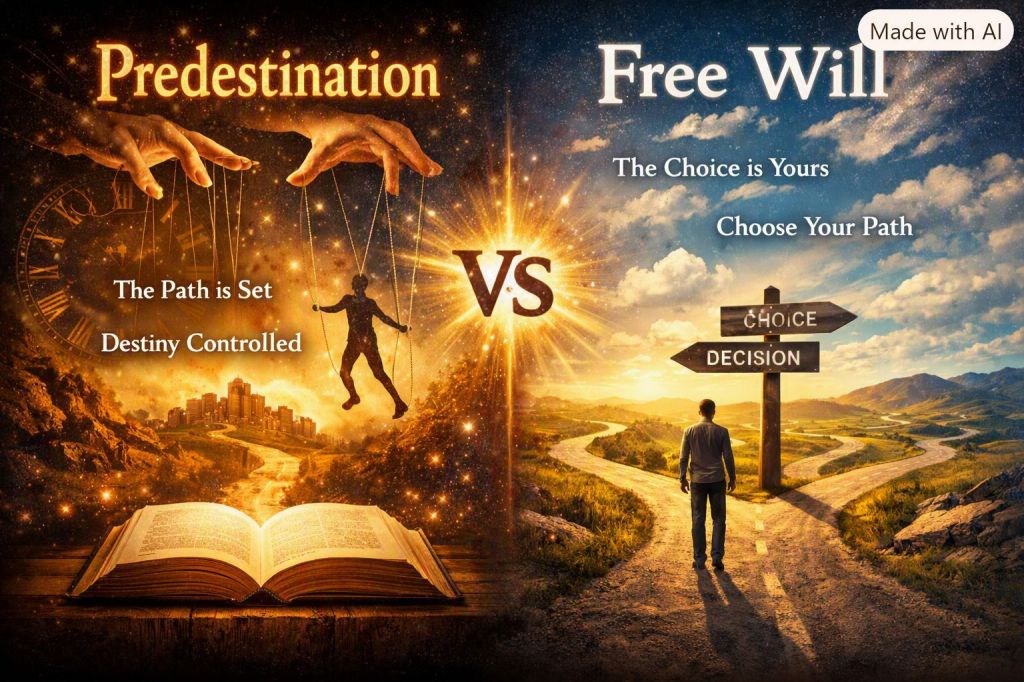
The question of predestination versus free will has stirred believers, rabbis, pastors, and philosophers for thousands of years.
Some imagine a universe where every detail is already scripted, leaving humans as actors reading lines they never chose.
Others insist that life is an open field of possibility, shaped moment by moment by human decisions. But Scripture, Jewish wisdom, and even secular philosophy point to a more profound truth: we choose freely, and God already knows the choice, yet His knowing does not force our choosing.
God’s sovereignty and human responsibility are not enemies; they are partners in the story of redemption.
Biblically, God’s omniscience is unmistakable. Psalm 139:4 declares, “Before a word is on my tongue, You know it completely,” revealing a God who sees not only actions but intentions. Isaiah 46:10 describes Him as “declaring the end from the beginning,” meaning He stands outside time and sees the entire timeline at once. Yet Scripture also affirms human choice with equal force. Deuteronomy 30:19 says, “I have set before you life and death… therefore choose life,” and Revelation 22:17 proclaims, “Whosoever will may come.” These passages make it clear that human decisions are real, meaningful, and consequential. Jewish wisdom literature captures this tension perfectly: “Everything is foreseen, yet freedom of choice is given” (Pirkei Avot 3:15). God knows the house you will build, but you still swing the hammer. Even Paul’s language supports this model. In Romans 8:29 he speaks of those “whom He foreknew,” emphasizing God’s knowledge rather than divine coercion.
God knows the future because He is outside time, not because He forces it.
Philosophers have wrestled with the same tension. Aristotle taught that humans possess multiple potentials, and choice determines which potential becomes real. Boethius, writing in The Consolation of Philosophy, argued that God exists outside time and therefore sees all moments simultaneously; His knowledge does not cause human actions. Thomas Aquinas reinforced this idea by insisting that knowledge does not cause events, just as watching a recording does not change the game. Modern compatibilist philosophers echo this by arguing that an ordered universe can still contain genuine human freedom. These secular perspectives align surprisingly well with the biblical model, showing that the tension between divine foreknowledge and human choice is not only theological but deeply human.The key insight is simple: knowledge does not equal control. If someone watches a video of you choosing pancakes over waffles, their knowledge of your choice does not force your choice. They simply know it because they have seen it. God’s foreknowledge works the same way, except He sees the “video” before you live it. You are still choosing, and He is still knowing. Neither cancels the other. This means your choices genuinely shape your destiny. Your calling, growth, and character are real decisions, not predetermined illusions. God’s plan includes your freedom, weaving redemption into your choices rather than around them. Responsibility remains intact; if everything were predestined, sin would not be your fault and righteousness would not be meaningful. Prayer, repentance, obedience, and discipleship make sense only if your choices matter.The most coherent view—biblically, philosophically, and experientially—is this: God knows the whole map, and you choose the path. His knowledge does not force your steps, and your freedom does not threaten His sovereignty. This is the tension where faith becomes meaningful and relationship becomes real. God’s foreknowledge is not a cage; it is a comfort. He already sees the redemption He will weave from your choices, the healing He will bring from your wounds, and the purpose He will draw from your journey. You are not trapped in a script. You are invited into a partnership.


Leave a Reply