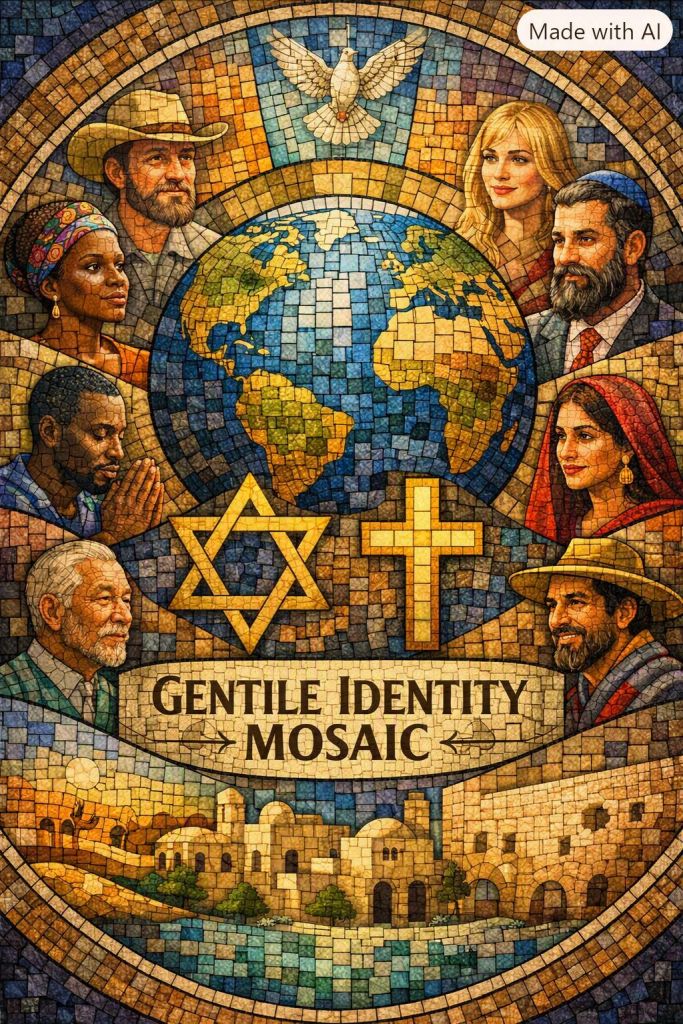
There’s a quiet struggle I see all the time in the Messianic world — and I’ve felt it myself. It’s when a Gentile believer says, “I’m not Gentile anymore,” or “I wish I were born Jewish.” Sometimes it’s said jokingly, sometimes with longing, sometimes with pain. But underneath it is a deeper question:
Did God make a mistake when He made me Gentile? A rabbi I trust once said something that hit me hard:
“A Jew is a Jew. A Gentile is a Gentile. HaShem made you as you are — accept it.”
Not as resignation, but as purpose.
God didn’t make a mistake — He made a mosaic. He could have made every human being Jewish. He didn’t. He chose a small nation to carry a massive calling, and He chose the rest of humanity to carry another calling. Not lesser, not secondary, not “almost chosen,” just different, intentionally.
From Adam to Noah, from Abraham to Moses, God shaped a people who would carry His instructions — not just for themselves, but for the world. Israel was called a nation of priests, a light to the nations, guardians of the covenant, teachers of God’s ways.
Think of any classroom: thirty students, one teacher. The teacher isn’t “better,” they just have a different job. That’s Israel.
Gentiles were never an afterthought, never second‑class, never spiritually inferior.
From the beginning, God was forming a multi‑ethnic family: Adam → Noah → Abraham’s mixed multitude → the nations in the prophets → Romans 11 → Ephesians 2.
Gentiles don’t become Jews. Gentiles become righteous Gentiles who worship the God of Israel. That’s the biblical pattern. And here’s something important: God never created the church to replace Israel. He didn’t create a “new chosen people.” He didn’t cancel the covenant with the Jewish people.
Replacement theology didn’t come from Scripture — it came from history, politics, and misunderstanding. The church was meant to be a gathering of nations who worship the God of Israel, a place where Gentiles learn from Israel’s Scriptures, a community grafted into Israel’s story, not over it.
God’s plan was never “Israel OR the church.” It was always Israel AND the nations — working together, honoring each other’s calling. So why do so many Gentiles say, “I wish I were Jewish”? I’ve heard it in synagogues, Bible studies, and conversations over coffee.
I’ve even felt it myself. It usually comes from longing to belong to the original covenant people, insecurity about spiritual worth, romanticizing Jewish identity, or misunderstanding the roles God assigned. But Gentile identity is not a downgrade — it’s a calling.
You weren’t born Gentile by accident. You weren’t placed in your nation by mistake. You weren’t given your heritage as a consolation prize.
HaShem positioned you exactly where He wanted you. Jews and Gentiles have two callings, one purpose: Jews teach Torah. Gentiles live Torah across the world.
Israel is the priesthood. The nations are the congregation. Priests aren’t better. Congregations aren’t less. Both are necessary. Both are holy. Both are intentional. When a Gentile says, “I wish I were Jewish,” what they’re really saying is, “I wish I felt chosen.” But they are chosen — just not for the same role. And that’s the beauty of it.
The most Jewish thing a Gentile can do is not convert, not pretend, not erase their identity, but to say: “I am a Gentile who worships the God of Israel and honors His people.”
That is righteous.
That is biblical.
That is beautiful.
Gentile identity is not a mistake. It’s part of the mosaic God designed from the beginning.
As you’re reading this, you might notice a part of you becoming curious… curious about how your own identity fits into God’s design… curious about how others might need to hear this today. And as that curiosity grows, you may find yourself commenting your thoughts, sharing this with someone who needs it, and subscribing so you don’t miss the next reflection — almost before you realize you’ve done it.
Because sometimes the message that settles deepest is the one we pass along.
 Chavurat Derekh HaMashiach
Leave a comment